
Your business website looked impressive when you first launched it. The colours were fresh, the design was modern, and everything worked as expected. But a few years later, you might notice that visitors aren’t staying long, enquiries have slowed down, or your competitors’ websites look more professional.
Does this mean your website needs a complete makeover?
Not necessarily. Some issues can be fixed with minor improvements. However, when outdated design, poor performance, and usability problems begin affecting business growth, a website redesign may be the smarter investment.
As we move into 2027, customers expect websites to be fast, mobile-friendly, easy to navigate, and trustworthy. Your website should also support your marketing strategy and make it simple for potential customers to contact you.
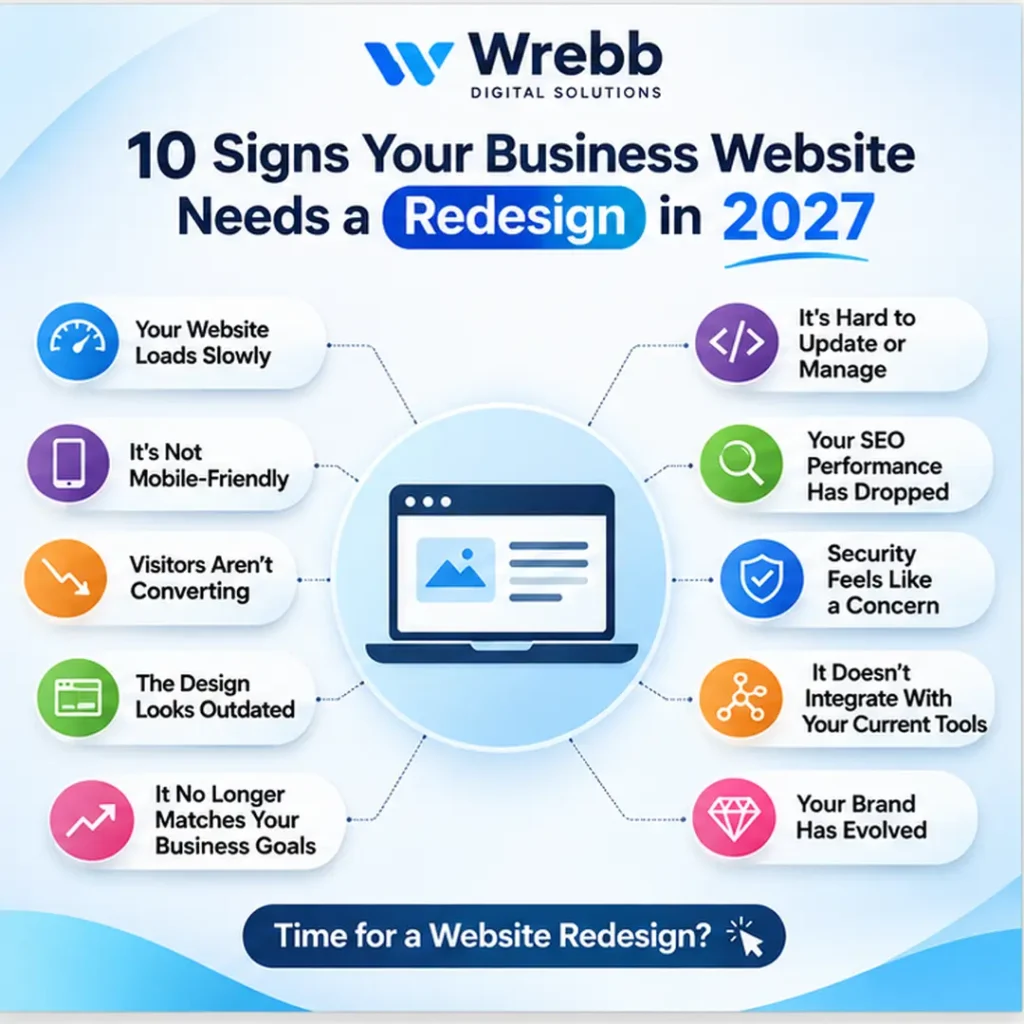
Here are ten warning signs that your business website may need a fresh approach.
1. Your Website Looks Outdated Compared to Competitors
First impressions matter, particularly when potential customers are comparing multiple service providers.
Imagine visiting two websites offering similar services. One has a clean layout, appealing visuals, and clearly presented information. The other features crowded pages, outdated graphics, inconsistent fonts, and confusing navigation.
Which business would you feel more comfortable contacting?
An outdated appearance doesn’t necessarily mean your products or services are inferior. However, it can create unnecessary doubts about your professionalism.
What should you look for?
- Inconsistent colours, fonts, and page layouts
- Outdated banners and low-quality images
- Overcrowded pages with limited white space
- Navigation menus that are difficult to understand
- A design that no longer reflects your brand identity
A modern website should communicate your value clearly without overwhelming visitors.
2. Your Website Isn’t Mobile-Friendly
Have you checked how your website looks on a smartphone recently?
Your desktop website might look perfect, but that doesn’t guarantee a smooth experience on smaller screens.
Visitors may struggle with tiny text, overlapping images, difficult-to-tap buttons, or forms that don’t display correctly.
Google uses the mobile version of a website’s content for indexing. Its official mobile-first indexing guidance also recommends creating mobile-friendly websites that provide a strong user experience.
Source: Google Search Central: Mobile-First Indexing Best Practices
How can you identify mobile usability problems?
Open your website on different smartphones and tablets. Try navigating between pages, completing contact forms, and clicking important buttons.
If these simple actions become frustrating, your website may need responsive web design improvements.
A mobile-friendly website should adjust naturally to different screen sizes while keeping navigation and content accessible.
3. Your Website Takes Too Long to Load
Nobody enjoys waiting for a website to load, especially when competing businesses are only a click away.
Slow-loading pages can interrupt the customer journey. Visitors may abandon product pages, leave before viewing your services, or give up on submitting an enquiry.
Google evaluates aspects of website performance through Core Web Vitals, including:
- Largest Contentful Paint (LCP): Measures how quickly the main content loads.
- Interaction to Next Paint (INP): Evaluates responsiveness to user interactions.
- Cumulative Layout Shift (CLS): Measures unexpected visual movement.
Google recommends achieving an LCP of 2.5 seconds or less, INP of 200 milliseconds or less, and CLS of 0.1 or less for a good experience.
Source: Google Search Central: Core Web Vitals
What causes poor website performance?
Common issues include oversized images, excessive plugins, inefficient code, unnecessary scripts, and inadequate hosting.
A professional website redesign can address underlying performance problems, although some websites may only require targeted optimization.
4. Your Website Gets Visitors but Generates Few Enquiries
Your website receives traffic through Google, social media, and advertising campaigns. Yet very few visitors fill out the contact form, call your business, or request a quotation.
This is a sign that your website might not be guiding visitors towards meaningful actions.
Sometimes, the problem isn’t the traffic. It’s the experience visitors encounter after arriving.
Common website conversion problems
- Important calls to action are difficult to find.
- Service pages don’t explain the benefits clearly.
- Contact forms ask for unnecessary information.
- Pricing or service details are confusing.
- Visitors struggle to find testimonials or credibility indicators.
Website conversion optimization focuses on making the customer journey simpler and more persuasive.
For example, a clear “Request a Free Quote” button placed near relevant service information may be more helpful than a generic “Learn More” button.
Before redesigning, review your analytics to identify where visitors lose interest.
5. Your Website No Longer Reflects Your Business Goals
Businesses evolve, but their websites don’t always keep up.
Perhaps you started with three services and now offer ten. Maybe you’ve expanded into new cities, changed your target audience, or introduced ecommerce functionality.
If your website still communicates your original business model, visitors may never discover what you currently offer.
A growing company needs a website that supports its present goals rather than its past limitations.
When should you update your website structure?
Consider a business website redesign when you’ve:
- Introduced new products or services
- Expanded into different markets
- Changed your brand positioning
- Added new customer segments
- Shifted towards online sales or lead generation
Your website should make it easy for customers to understand who you serve, what you offer, and why they should choose your business.
6. Updating Website Content Has Become Difficult
Adding a new blog, changing a product description, or updating service information shouldn’t require hours of technical work.
Yet many businesses continue using outdated website systems that make even basic content changes complicated.
This creates a bigger problem than inconvenience. Your marketing team may delay updates, publish less frequently, or depend on developers for every small modification.
How can modern website development help?
A content management system such as WordPress can make routine content management more convenient.
Depending on your requirements, developers can introduce reusable page templates, structured content sections, flexible layouts, and simplified administrative controls.
The goal isn’t to eliminate development support entirely. It’s to give your team greater independence when managing everyday website content.
If your existing system consistently slows down marketing activities, upgrading your website’s underlying technology may be worthwhile.
7. Your Website’s SEO Performance Is Declining
Have your important service pages gradually lost organic visibility? Are competitors appearing for searches where your business previously performed well?
Declining rankings don’t automatically indicate that your website design is responsible. Competition, content quality, technical errors, and changing search behaviour can all influence SEO performance.
However, poor website architecture can make these challenges worse.
Website issues that may affect SEO
- Broken internal links
- Duplicate or poorly organized pages
- Confusing URL structures
- Slow-loading pages
- Important content missing from mobile pages
- Crawlability and indexing problems
Modern SEO-friendly website design should consider search engines and users together.
With AI-powered search experiences becoming more prominent, clearly structured, accessible, and useful website content is also increasingly valuable for discoverability.
Before proceeding with a website redesign, conduct a technical SEO audit to identify which issues genuinely require structural changes.
8. Your Website Has Security and Accessibility Problems
A website that looks attractive but lacks basic security measures can expose your business to unnecessary risks.
Outdated software, unsupported plugins, poor access controls, and neglected maintenance may create vulnerabilities.
Similarly, inaccessible website elements can prevent some visitors from using important services.
For example, customers may struggle with forms that lack proper labels, images without meaningful alternative text, or navigation that doesn’t work with a keyboard.
What should your website support?
Your website should have appropriate security controls, maintained software, secure connections, and reliable backup procedures.
For accessibility, the World Wide Web Consortium recommends following Web Content Accessibility Guidelines (WCAG) 2.2, which address important usability needs for people with disabilities.
Source: W3C: WCAG 2.2 Guidelines
Some security and accessibility problems can be resolved without changing the overall design. More widespread structural issues may justify a comprehensive upgrade.
9. Your Website Doesn’t Integrate with Your Business Tools
Your website should do more than display company information.
Modern businesses often need their websites to work with customer relationship management software, payment gateways, appointment systems, email marketing platforms, and inventory management tools.
Without suitable integrations, employees may spend unnecessary time transferring information between systems.
For example, an enquiry submitted through your website could automatically enter your CRM, notify the sales team, and trigger an appropriate follow-up.
When does integration become a redesign priority?
If your existing website cannot support essential integrations or business automation without major workarounds, it may be time to reconsider its technical architecture.
A well-planned web development project can improve operational efficiency while creating a smoother experience for customers.
10. Your Branding Has Changed, but Your Website Hasn’t
Your brand is more than a logo.
It includes your messaging, visual identity, target audience, values, and the experience customers associate with your business.
If you’ve refreshed your logo, introduced new brand colours, or repositioned your services, your website should communicate the same identity.
Inconsistent branding across your website, social media, proposals, and marketing campaigns can weaken recognition.
A redesign gives you the opportunity to establish consistent visual elements and messaging.
More importantly, it helps communicate what makes your business different in a competitive market.
Website Redesign vs Website Refresh: Which Do You Need?
Not every website problem requires starting from scratch.
Sometimes, a focused website refresh can deliver the improvements your business needs.
| Website refresh | Website redesign |
|---|---|
| Updates selected visual elements | Reworks the overall design and experience |
| Improves existing content | May restructure content and navigation |
| Fixes isolated usability issues | Addresses widespread usability problems |
| Retains the main website architecture | May involve architectural or platform changes |
| Suitable for minor improvements | Suitable for broader business requirements |
The right decision depends on the condition of your current website.
If your primary issue is an outdated homepage banner, a refresh may be sufficient. However, if your website suffers from poor navigation, weak conversions, technical limitations, and inconsistent branding, a comprehensive redesign could offer better long-term value.
What Should You Consider Before Redesigning Your Website?
A successful redesign begins with understanding what needs improvement rather than immediately selecting a new theme or layout.
Here is a practical website redesign checklist:
- Audit your existing website. Review performance, SEO, usability, accessibility, and conversion data.
- Define measurable goals. Decide whether you want more enquiries, better engagement, improved sales, or simpler content management.
- Understand your target audience. Identify the information and functionality visitors need.
- Plan your website structure. Organize important pages and navigation around customer requirements.
- Protect existing SEO value. Preserve useful content and URLs where appropriate, and create redirects for changed URLs.
- Test before launching. Check responsiveness, forms, integrations, page speed, and important customer journeys.
Google recommends carefully mapping old URLs to new destinations during website migrations and implementing appropriate permanent redirects.
Source: Google Search Central: Site Moves and Migrations
Planning these details early can reduce disruption and help protect the performance of your existing website.
Conclusion: Is It Time to Give Your Business Website a Fresh Start?
Your website doesn’t need a redesign simply because it’s a few years old. What matters is whether it continues to serve your customers and support your business objectives.
If your website struggles with slow performance, poor mobile usability, outdated branding, or declining conversions, those problems deserve attention.
A thoughtful website redesign can improve usability, strengthen your online presence, and create a better foundation for future growth.
At Wrebb Digital Solutions, we help businesses build professional, responsive, and SEO-friendly websites that reflect their brand and support their goals.
Whether you’re planning a complete website transformation or looking to improve an existing website, our team can help you identify the right approach.
Explore our web design services or visit Wrebb Digital Solutions to discuss your website requirements.
Frequently Asked Questions
1. How often should a business website be redesigned?
There is no fixed timeline. Review your website regularly and consider a redesign when outdated technology, poor usability, declining conversions, or changing business requirements affect performance.
2. How much does a website redesign cost in India?
Costs depend on the number of pages, design complexity, required integrations, content migration, and functionality. A detailed quotation based on your requirements provides a more reliable estimate.
3. Will redesigning my website affect SEO rankings?
It can, especially if URLs, content, and website architecture change. Proper SEO planning, redirects, testing, and post-launch monitoring can help minimize potential ranking disruptions.
4. How long does a business website redesign take?
A relatively simple business website may take several weeks, while complex projects can require longer. Timelines depend on design approvals, content availability, functionality, and testing requirements.
5. Can I redesign my website without changing its domain name?
Yes. Most businesses can redesign their websites while retaining their existing domain names. Maintaining important URLs where practical can also simplify SEO preservation.
6. Is website redesign necessary for improving conversions?
Not always. Targeted changes to content, forms, navigation, or calls to action may improve conversions. A complete redesign becomes relevant when broader usability or structural problems exist.