Choosing the right ecommerce platform is one of the most important decisions you will make when launching an online store. Your choice influences everything from development costs and customer experience to profit margins and future business expansion.
When comparing WooCommerce vs Shopify, business owners often struggle to decide between the flexibility of an open-source platform and the convenience of a fully hosted ecommerce solution.
Both platforms offer powerful features for selling online. However, they differ significantly in terms of pricing, customization, website ownership, SEO capabilities and ongoing maintenance.
Whether you are launching a D2C brand, taking your offline retail business online or upgrading an existing ecommerce website, this guide will help you make an informed decision for 2027.
What Is WooCommerce?
WooCommerce is an open-source ecommerce plugin that transforms a WordPress website into a fully functional online store. It allows businesses to sell physical products, digital downloads, subscriptions and services.
The core plugin is free. However, businesses need to invest in hosting, domain registration, development and any additional functionality they require.
One of the biggest advantages of WooCommerce is that it gives businesses extensive control over their website’s design, functionality and hosting environment. Developers can customize the platform to accommodate specific business requirements.
Key features of WooCommerce:
-
Extensive website customization options
-
No additional platform transaction fees
-
Flexible hosting options
-
Access to WordPress plugins and themes
-
Multiple payment gateway integrations
-
Advanced content management capabilities
Reference: Official WooCommerce website
What Is Shopify?
Shopify is a subscription-based, fully hosted ecommerce platform that helps businesses create and manage online stores without managing their own hosting infrastructure.
It combines website hosting, product management, inventory tracking, checkout and other ecommerce tools within a centralized dashboard.
Shopify is particularly attractive to entrepreneurs who want to launch an online store with minimal technical involvement. Merchants can select a theme, upload products, configure payments and start selling.
However, access to certain advanced features depends on the merchant’s subscription plan.
Key features of Shopify:
-
Managed ecommerce hosting
-
User-friendly store management dashboard
-
Integrated checkout functionality
-
Access to the Shopify App Store
-
Multichannel selling capabilities
-
Centralized technical support
Reference: Official Shopify website
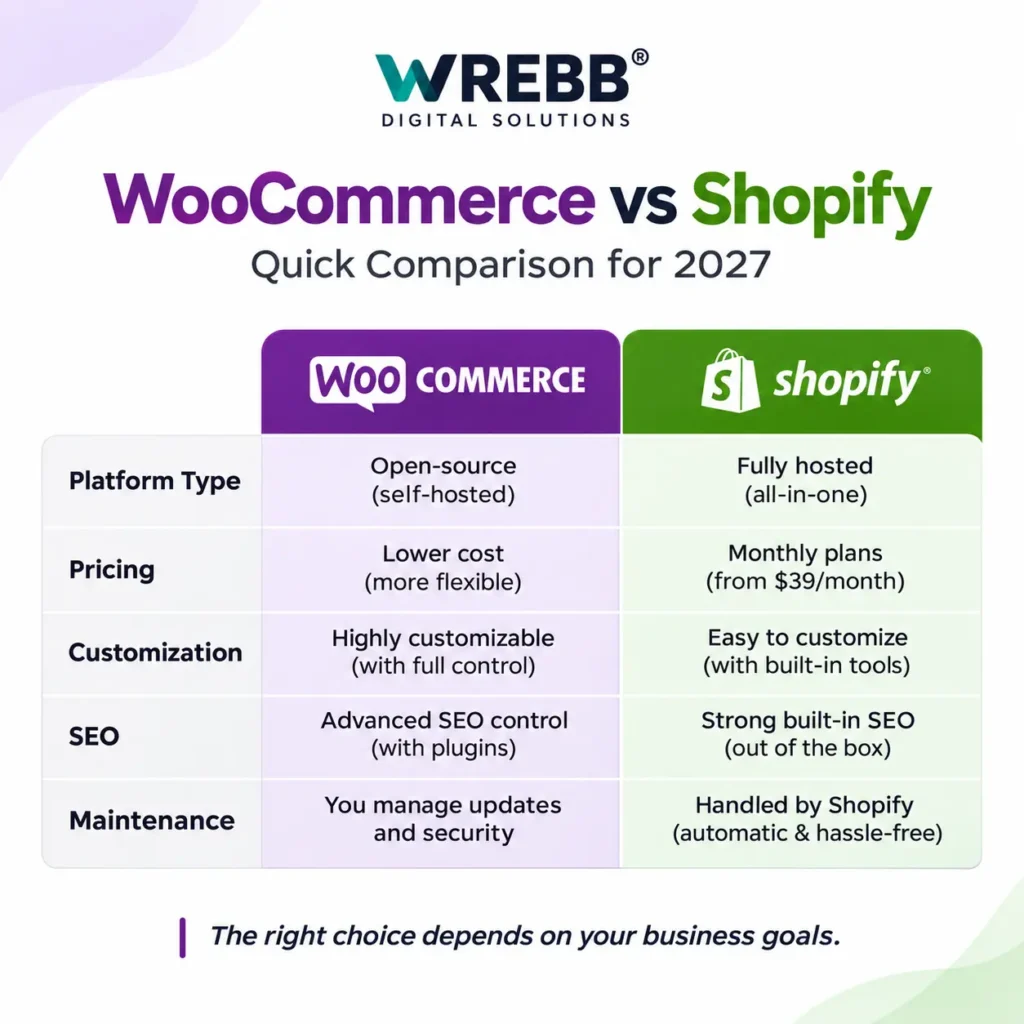
WooCommerce vs Shopify: A Quick Comparison
Before exploring the differences in detail, here is a side-by-side comparison of both ecommerce platforms.
| Comparison factor | WooCommerce | Shopify |
|---|---|---|
| Platform type | Open-source ecommerce plugin | Hosted ecommerce platform |
| Platform cost | Free core software | Paid subscription |
| Hosting | Purchased separately | Included in subscription |
| Ease of use | Requires initial technical setup | Beginner-friendly |
| Customization | Extensive code-level control | Within platform capabilities |
| Platform transaction fees | None | May apply, depending on payment provider and plan |
| SEO flexibility | Extensive through WordPress | Built-in SEO tools |
| Website infrastructure | Merchant-controlled | Shopify-managed |
| Maintenance | Merchant or development agency | Core infrastructure managed by Shopify |
| Scalability | Depends on hosting and optimization | Managed infrastructure and plan features |
| Technical support | Hosting providers, developers and extension providers | Centralized Shopify support |
| Best suited for | Businesses seeking flexibility and control | Businesses prioritizing convenience |
1. Pricing and Overall Ecommerce Development Costs
Budget is often the deciding factor when selecting an ecommerce platform. However, the initial setup cost does not always reflect the actual cost of running an online business.
WooCommerce pricing
The core WooCommerce plugin is free to install and does not charge a recurring platform subscription fee.
Businesses typically need to budget for:
-
Domain registration and web hosting
-
Website design and development
-
Premium plugins and themes
-
Payment gateway processing charges
-
Website security and maintenance
-
Custom functionality and integrations
The overall WooCommerce website development cost depends on the complexity of your online store.
A small retailer with a straightforward product catalogue may require fewer resources than a wholesaler offering customized pricing and bulk ordering.
Shopify pricing
Shopify follows a recurring subscription model. Its plans include ecommerce hosting and various built-in features.
According to Shopify’s official Indian pricing page, the following rates were listed in November 2026:
| Shopify plan | Monthly price with annual billing | Third-party transaction fee |
|---|---|---|
| Basic | ₹1,499 | 2% |
| Grow | ₹5,599 | 1% |
| Advanced | ₹22,680 | 0.6% |
| Plus | From ₹1,75,000 | 0.2% |
Shopify India
These subscription costs may not include premium themes, paid applications, payment processing charges or applicable taxes. Pricing may also change in 2027.
Which platform offers better value?
When evaluating WooCommerce vs Shopify from a financial perspective, consider the total cost of ownership over three to five years.
WooCommerce may offer better long-term value for businesses that want to control infrastructure expenses and avoid additional platform transaction fees. Shopify offers greater convenience through bundled hosting and centralized platform management.
References: WooCommerce pricing | Shopify India pricing
2. Ease of Use and Store Management
WooCommerce
WooCommerce requires an initial setup involving WordPress installation, hosting configuration, theme selection and plugin integration.
While the setup may require professional assistance, managing products, processing orders, updating inventory and creating discounts becomes relatively straightforward once the store is ready.
Partnering with an experienced WooCommerce development company can simplify the initial process considerably.
Shopify
Shopify offers a more streamlined onboarding experience. Business owners can manage their online store from a centralized interface without dealing directly with server configuration or software installation.
Verdict: Shopify has an advantage in initial ease of use, while WooCommerce offers greater flexibility for businesses willing to invest in professional development.
3. Website Design and Customization
Your ecommerce website should reflect your brand identity rather than look like every other online store in your industry.
WooCommerce customization capabilities
WooCommerce gives developers access to the underlying website code. This allows businesses to create tailored ecommerce experiences, including:
-
Custom product page layouts
-
Personalized checkout journeys
-
Industry-specific product filters
-
Wholesale pricing systems
-
Advanced product configuration
-
Customized shipping and delivery rules
This flexibility is particularly valuable for businesses with unique operational requirements.
Shopify customization capabilities
Shopify provides free and premium themes that businesses can customize using its theme editor. Developers can also create custom themes using Shopify’s development tools.
However, certain checkout modifications and advanced features depend on subscription levels and platform restrictions.
Verdict: WooCommerce is generally better suited to businesses requiring extensive customization, while Shopify works well for standardized ecommerce requirements.
4. SEO and Digital Marketing Capabilities
Organic search visibility plays an important role in reducing dependence on paid advertising and attracting potential customers.
The SEO capabilities of WooCommerce vs Shopify deserve careful consideration, especially if search engine optimization is central to your long-term marketing strategy.
WooCommerce SEO
Since WooCommerce operates within WordPress, businesses can benefit from its extensive content management ecosystem.
Store owners and SEO specialists can implement:
-
Customized URL structures
-
Product and category page optimization
-
Advanced schema markup
-
Strategic internal linking
-
Long-form blog content
-
Technical SEO improvements
-
Redirect and indexing management
Popular WordPress SEO plugins such as Yoast SEO and Rank Math can help manage many of these requirements.
Shopify SEO
Shopify includes built-in SEO functionality, such as automatically generated XML sitemaps and canonical tags. Merchants can also modify page titles, meta descriptions, URL handles and image alternative text.
SEO overview
However, certain aspects of website architecture remain governed by Shopify’s platform structure.
Verdict: Both platforms can perform well in search results. WooCommerce offers more technical flexibility, particularly for businesses investing heavily in content marketing and customized SEO strategies.
Reference: Shopify’s official SEO documentation
5. Payment Gateways and Transaction Fees
Payment processing costs directly affect ecommerce profit margins, particularly as order volumes increase.
WooCommerce payment options
WooCommerce supports multiple third-party payment solutions. Indian merchants can integrate providers such as Razorpay and offer eligible payment methods, including UPI, credit cards and debit cards.
WooCommerce does not impose an additional platform transaction fee. Merchants pay the applicable charges of their payment service providers.
Shopify payment options
Shopify supports multiple payment gateways. However, additional transaction fees can apply when businesses use third-party payment providers.
As of November 2026, Shopify Payments is not listed as available for India-based businesses. Indian merchants should therefore carefully evaluate their payment gateway and platform transaction costs.
Verdict: WooCommerce can be financially attractive for businesses looking to avoid additional platform-level transaction charges.
References: Razorpay for WooCommerce | Shopify Payments supported countries
6. Website Performance and Scalability
As your online business grows, your ecommerce website must accommodate increasing traffic, product listings and order volumes without compromising customer experience.
WooCommerce scalability
WooCommerce allows businesses to upgrade their hosting infrastructure as their requirements evolve.
Developers can improve website performance through caching, database optimization, image compression and content delivery networks (CDNs).
However, choosing an unsuitable hosting provider or installing unnecessary plugins can negatively affect website speed.
Shopify scalability
Shopify manages the underlying hosting infrastructure, reducing the technical burden on merchants during periods of increased traffic.
Businesses may need to upgrade their subscription plans when they require additional staff accounts, advanced reporting or specialized ecommerce functionality.
Verdict: Both platforms support business growth. WooCommerce provides greater infrastructure control, while Shopify simplifies infrastructure management.
Reference: WooCommerce scalability and FAQs
7. Website Security and Maintenance
Ecommerce security is essential for protecting customer information, maintaining business continuity and building consumer trust.
WooCommerce security
WooCommerce store owners are responsible for maintaining a secure website environment.
Regular maintenance involves updating WordPress, themes and plugins, monitoring vulnerabilities, performing backups and ensuring secure payment processing.
Hiring a professional development agency can help businesses manage these responsibilities.
Shopify security
Shopify provides managed hosting, SSL certificates and PCI DSS-compliant infrastructure. This reduces several technical security responsibilities for merchants.
However, businesses must still manage account security, staff access and the applications they install.
Verdict: Shopify simplifies technical maintenance, whereas WooCommerce provides greater control over website security and maintenance practices.
References: WooCommerce PCI compliance documentation | Shopify security and hosting information
8. Website Ownership and Third-Party Integrations
Website ownership becomes increasingly important as your business expands.
With WooCommerce, businesses have direct access to their website files, databases and underlying code. They can change hosting providers, develop custom integrations and modify website functionality.
Shopify allows merchants to manage their store and export supported business data. However, the underlying ecommerce platform remains proprietary.
Both platforms support integrations with CRM software, inventory management systems, shipping providers and email marketing tools.
WooCommerce offers more freedom when businesses require specialized integrations that go beyond standard ecommerce functionality.
Which Ecommerce Platform Is Better for Indian Businesses?
Indian ecommerce businesses often have specific requirements related to UPI payments, GST invoicing, cash on delivery, shipping integrations and regional delivery restrictions.
When comparing WooCommerce vs Shopify for the Indian market, businesses should consider how easily and affordably each platform accommodates these requirements.
WooCommerce can be particularly beneficial for retailers, wholesalers, manufacturers and D2C brands that require customized business functionality.
Shopify is a suitable alternative for entrepreneurs who prefer a managed platform and want to minimize technical responsibilities.
Ultimately, your business model, budget and growth plans should guide your decision.
When Should You Choose WooCommerce or Shopify?
Here is a practical checklist to help you choose the best ecommerce platform for your business.
Choose WooCommerce if:
-
You want extensive control over your website.
-
Your business already has an existing WordPress website.
-
Customized ecommerce functionality is essential to your business operations.
-
Avoiding additional platform transaction fees is a priority.
-
Content marketing and SEO are priorities.
-
You have access to professional development support.
-
Choose Shopify if:
-
You want to launch your store quickly.
-
Managed hosting is your preferred option.
-
Your technical knowledge is limited.
-
Standard ecommerce features meet your business needs.
-
A subscription-based platform suits your budget.
-
Centralized platform support is important to you.
Conclusion
The decision between WooCommerce vs Shopify ultimately depends on your business requirements, technical capabilities and long-term ecommerce objectives.
While Shopify offers convenience through a managed platform, WooCommerce stands out for its customization capabilities, website control, flexible cost structure and SEO potential.
If you want to build an online store that adapts to your evolving business needs, WooCommerce is worth considering.
At Wrebb Digital Solutions, we offer professional WooCommerce and WordPress development services tailored to your business requirements. From responsive ecommerce website design to payment gateway integration and custom functionality, our team helps you build an online store designed to support long-term business growth.
Planning to launch or upgrade your ecommerce website? Connect with Wrebb Digital Solutions to discuss your requirements.
Frequently Asked Questions (FAQs)
1. Is WooCommerce cheaper than Shopify?
WooCommerce can be more affordable depending on hosting, development and maintenance costs. Unlike Shopify, it does not charge a recurring core platform subscription or additional platform transaction fees.
2. Which platform is better for ecommerce SEO?
Both platforms offer effective SEO capabilities. However, WooCommerce provides greater flexibility over URL structures, content management, technical SEO configurations and advanced optimization through the WordPress ecosystem.
3. Can I migrate my Shopify store to WooCommerce?
Yes. Businesses can migrate products, customer records and supported order data to WooCommerce. Professional migration services can help minimize downtime, data loss and disruptions to SEO performance.
4. Is WooCommerce suitable for large ecommerce businesses?
Yes. With reliable hosting, optimized databases, appropriate caching and professional development support, WooCommerce can accommodate large product catalogues, substantial website traffic and high order volumes.
5. Which ecommerce platform is better for small businesses in India?
WooCommerce suits small businesses seeking customization and control over recurring expenses. Shopify is suitable for entrepreneurs who prioritize quick setup, ease of use and managed infrastructure.