Your website is often the first real interaction a potential customer has with your business. Before they call, fill out a form, visit your store, or request a quote, they are likely to check your website.
Table of Contents
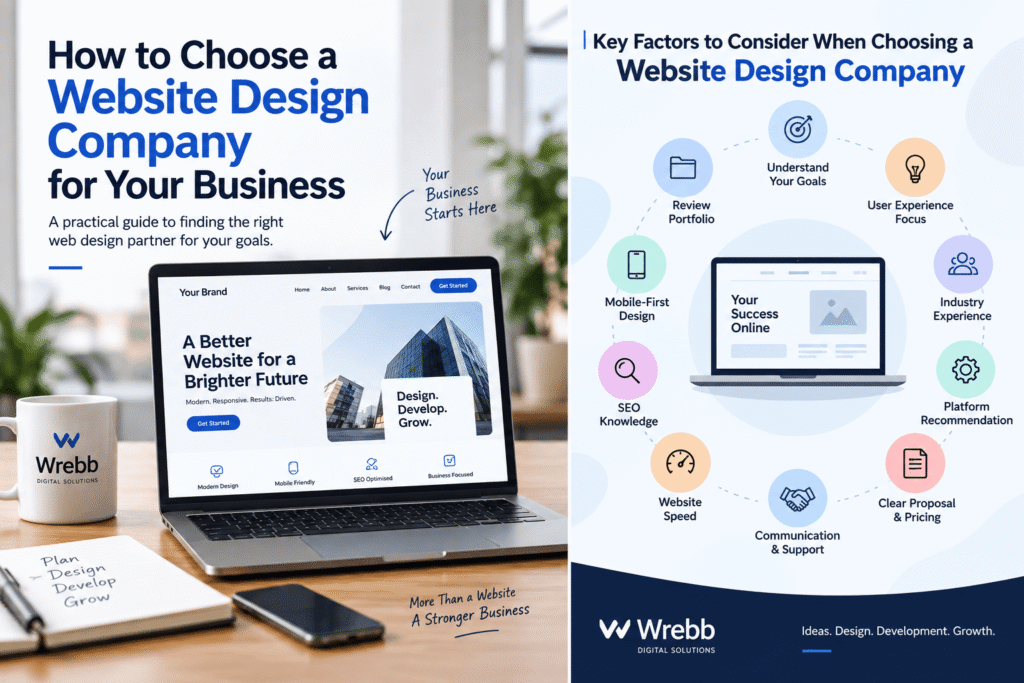
ToggleThat means choosing the right Website design company is not just about getting a site that looks attractive. It is about finding a team that understands your business, your customers, your goals, and how all of these should come together online.
The challenge is that almost every web designing agency promises modern layouts, mobile-friendly pages, fast loading speed, and great user experience. So how do you separate a capable partner from one that simply has a good sales pitch?
Here is a practical way to evaluate your options and choose a web design partner that fits your business.
1. Start With Your Business Goals, Not the Design
Before you begin comparing agencies, get clear about what you want your website to achieve.
Do you want to generate leads? Sell products? Build credibility? Book appointments? Showcase a portfolio? Support local SEO? Or simply replace an outdated website?
Your goals will shape the kind of Website design company you need.
For example, an ecommerce business needs strong product navigation, payment integration, checkout optimization, and inventory functionality. A service business, on the other hand, may need strong landing pages, lead forms, local SEO elements, and clear calls to action.
Create a basic list of your priorities, such as:
- Main objective of the website
- Important pages
- Features you need
- Preferred platform
- Target audience
- Budget range
- Expected launch timeline
This makes agency conversations more productive and helps you compare proposals properly.
2. Review the Company’s Portfolio Carefully
A portfolio is one of the best ways to understand what a web designing company can actually deliver.
Do not look only at whether the websites appear attractive. Explore the live sites whenever possible.
Ask yourself:
- Is the navigation simple?
- Does the site look good on mobile?
- Are important calls to action easy to find?
- Does every website look different?
- Do the designs suit the respective industries?
- Is the information easy to scan?
A strong portfolio should show variety.
If every project uses almost the same layout, colours, and page structure, the agency may rely heavily on templates rather than creating solutions around each client’s requirements.
The right website design agency should be capable of adapting the design to different audiences and industries.
3. Check Whether They Understand User Experience
A beautiful website is useful only if visitors can understand and use it easily.
This is where user experience, or UX, becomes important.
A professional Website design company should think about questions such as:
- What does the visitor want to find first?
- How many clicks does it take to reach an important page?
- Are buttons clearly visible?
- Is the page easy to read?
- Are forms simple enough?
- Does the mobile version work properly?
Good web design guides visitors naturally through the website.
For example, if you run a consulting business, visitors should quickly understand what you offer, who you work with, why they should trust you, and how to contact you.
If they need to search through five pages before understanding your services, the design is not doing its job.
4. Ask About Mobile-First and Responsive Design
A website that looks excellent on desktop but performs poorly on mobile can create serious problems.
Your site should adapt smoothly to different screen sizes, including smartphones, tablets, laptops, and desktops.
Ask your web designing agency how they approach responsive design.
Check whether they optimise:
- Menus
- Fonts
- Images
- Forms
- Buttons
- Tables
- Product grids
- Page speed
- Navigation
Do not assume mobile responsiveness is automatically handled properly. Ask for examples of recent projects and test them yourself on your phone.
A professional agency should design mobile usability from the beginning rather than treating it as a final adjustment.
5. Find Out Which Platform They Recommend and Why
Different businesses need different platforms.
WordPress may be ideal for a content-heavy business website. WooCommerce may suit certain ecommerce projects, while Shopify may make sense for businesses that want a specialised ecommerce platform.
A reliable Website design company should explain why it recommends a particular platform.
Be cautious if an agency automatically pushes the same technology for every project.
Ask questions such as:
- Will I be able to edit pages myself?
- Can the website scale later?
- Will additional features be easy to add?
- Who owns the website?
- Are there recurring licence costs?
- Can another developer maintain the site later?
You want a solution that works for your business long after the website has been launched.
6. Check Their SEO Understanding
Website design and SEO should not be treated as completely separate activities.
A poorly structured website can create SEO issues even if it looks impressive.
Your website structure affects elements such as:
- Internal linking
- Page speed
- URL structure
- Mobile usability
- Crawlability
- Heading hierarchy
- Image optimization
- Core Web Vitals
That is why it helps to choose a web designing company that understands SEO fundamentals.
Ask whether SEO considerations are included during development.
For example, check whether the agency follows SEO-friendly practices such as creating clean URLs, compressing images, using proper H1 and H2 structures, and setting up redirects correctly during a website redesign.
You do not necessarily need your design agency to manage your entire SEO campaign, but technical SEO should be considered while building the website.
7. Ask How They Approach Website Speed
Website speed affects both user experience and overall website performance.
Slow websites frustrate visitors. A potential customer may simply leave if a page takes too long to load.
Ask your Website design company what steps it takes to improve performance.
These may include:
- Compressing images
- Reducing unnecessary scripts
- Optimizing CSS and JavaScript
- Using efficient plugins
- Implementing caching
- Choosing suitable hosting
- Using modern image formats
This is especially important for WordPress websites, where excessive plugins and poorly optimized themes can create performance issues.
A visually impressive site that takes several seconds to display basic content may not deliver the business results you expect.
8. Understand What Is Included in the Proposal
Do not select an agency based only on the final price.
Two proposals may look similar but include completely different levels of work.
Ask for a clear breakdown covering:
- Number of pages
- Custom design
- Responsive development
- Content upload
- Forms
- Blog setup
- Basic SEO
- Speed optimization
- Analytics integration
- Security
- Testing
- Launch support
Also check whether content writing, stock images, premium plugins, hosting, and maintenance are included or charged separately.
A transparent website design agency should clearly define what is included and what is outside the project scope.
This helps prevent unexpected costs later.
9. Look at Their Communication Process
Website projects involve plenty of communication.
You may need to discuss layouts, content, images, functionality, revisions, forms, and technical issues.
That is why communication quality matters almost as much as design quality.
During your early discussions, notice how the agency responds.
Pay attention to whether the agency understands your questions, explains technical topics in simple terms, and takes the time to learn about your target customers and business goals.
A good Website design company should behave more like a partner than an order-taking vendor.
Clear communication also reduces delays and avoids misunderstandings during development.
10. Ask About the Design and Development Process
Professional agencies normally follow a structured process.
A typical workflow might include:
- Requirement gathering
- Competitor research
- Sitemap planning
- Wireframes
- Visual design
- Development
- Content integration
- Testing
- Client review
- Launch
Ask the agency to explain its workflow.
If a web designing agency immediately starts building pages without discussing your audience, structure, content, or objectives, that can be a warning sign.
Planning at the beginning usually saves significant time later.
11. Check Whether Content Is Considered During Design
Content and design should work together.
Many businesses make the mistake of designing every page first and adding content at the end.
This often results in awkward layouts, long blocks of copy, or missing information.
Ideally, your web designing company should consider important content elements during the planning stage.
For example:
- Main page heading
- Value proposition
- Service descriptions
- Testimonials
- FAQs
- Calls to action
- Contact information
If your business already has SEO content planned, share it with the design team early.
That way, the layout can support both users and search engines.
12. Ask About Ownership and Access
This is easy to overlook.
Once the website is complete, you should have appropriate access to the systems connected to it.
Depending on your setup, that may include:
- WordPress administrator access
- Domain access
- Hosting account
- Google Analytics
- Google Search Console
- Google Business Profile
- Plugin licenses
- Design files
Make sure you understand what you own and what remains under the agency’s account.
A reputable Website design company should be transparent about access and ownership.
You should not find yourself completely dependent on one developer simply because you do not have access to your own website.
13. Understand Maintenance and Post-Launch Support
Launching the website is not the end of the process.
Websites need ongoing attention.
WordPress updates, plugin compatibility, backups, security monitoring, content changes, and performance optimization may all be required over time.
Ask your website design agency what happens after launch.
Do they offer:
- Website maintenance?
- Technical support?
- Security updates?
- Backups?
- Content updates?
- Performance monitoring?
You may not need a monthly maintenance plan, but understanding your options can help you avoid problems later.
14. Look Beyond the Cheapest Quote
Cost matters, especially for small businesses. But choosing solely based on price can be expensive in the long run.
A very low-cost website may use generic templates, weak development practices, poor mobile optimization, or little attention to SEO.
If you have to rebuild the entire site after six months, the cheaper option was not actually cheaper.
Instead, compare value.
Look at:
- Experience
- Portfolio
- Process
- Technology
- Support
- Customisation
- SEO knowledge
- Communication
The goal is not necessarily to find the most expensive provider. It is to find a Website design company that can deliver the right website for your business at a reasonable cost.
Conclusion
Choosing a web design partner deserves more attention than simply browsing a few portfolios and comparing prices.
Your website plays an important role in how customers discover, evaluate, and contact your business. The right agency should therefore understand design, usability, mobile performance, development, SEO, and your wider business goals.
Take time to review portfolios, discuss the process, ask about technology, check what is included in the proposal, and understand the level of support offered after launch.
Most importantly, choose a team that asks questions about your business rather than simply trying to sell you a website package.
If you are looking for a Website design company that combines thoughtful design, responsive development, SEO awareness, and practical business understanding, Wrebb Digital Solutions can help you build a website that is not only visually appealing but also structured to support visibility, user experience, and conversions.
A well-planned website should not just look professional. It should help people find information quickly, understand why your business is relevant, and take the next step.
Frequently Asked Questions
1. How do I choose the best web design company for my business?
Start by reviewing the company’s portfolio, experience, development process, SEO knowledge, responsive design capabilities, communication style, pricing, and post-launch support. Choose an agency that understands your business goals rather than focusing only on visual design.
2. What should I ask a web designing agency before hiring them?
Ask about the platform they recommend, project timeline, number of revisions, SEO features, mobile responsiveness, page speed, content requirements, website ownership, ongoing maintenance, and what exactly is included in the quoted price.
3. How much does professional website design cost?
Website design costs vary based on the number of pages, design complexity, platform, custom functionality, ecommerce features, integrations, and content requirements. A simple business website will generally cost less than a custom ecommerce or membership platform.
4. Should I choose a freelancer or a website design agency?
Both can work depending on your requirements. Freelancers may suit smaller projects, while an established agency may provide access to designers, developers, SEO specialists, content professionals, and ongoing support under one team.
5. Is WordPress a good option for a business website?
For many businesses, yes. WordPress is flexible, scalable, and easy to manage. It supports blogs, service websites, landing pages, ecommerce through WooCommerce, and a wide range of integrations. However, the best platform depends on your specific requirements.
6. How long does it take to design a business website?
A standard business website may take several weeks, while complex websites can take longer. The timeline depends on page count, custom design, functionality, content availability, approvals, and the number of revisions required.
7. Why is SEO important during website design?
SEO considerations such as site structure, page speed, mobile usability, heading hierarchy, internal linking, URL structure, and crawlability should be addressed during development. Fixing these issues after launch can require additional work.
8. Should a web design company also provide website maintenance?
It is helpful but not mandatory. Ongoing maintenance can include updates, backups, security monitoring, technical troubleshooting, performance optimization, and minor content changes. Ask what support options are available before signing the contract.