Not long ago, searching online usually meant typing a few keywords into Google, scanning the results, and visiting different websites to find an answer.
Today, that experience is changing.
Users can ask ChatGPT to recommend a service provider, request product comparisons through Google’s AI-powered search experiences, or use Microsoft Copilot to research business solutions. Instead of navigating several websites, they may receive a summarized response with links to relevant sources.
Naturally, this raises an important question for business owners: Is traditional search engine optimization still relevant?
The growing discussion around AI SEO vs traditional SEO isn’t about choosing one approach over another. It’s about understanding how search behaviour is evolving and adapting your digital marketing strategy accordingly.
Let’s explore what has changed, which SEO fundamentals remain essential, and how businesses can prepare for search in 2027.
What Is Traditional SEO?
Traditional search engine optimization focuses on improving a website’s visibility in organic search results on platforms such as Google and Bing.
The objective is to help search engines discover, understand, index, and rank relevant website pages for user searches.
For example, someone searching for “WooCommerce development company in India” might find service pages, agency listings, and informational articles in the search results.
Businesses use several techniques to improve their chances of appearing for relevant queries.
Core Components of Traditional SEO
On-page SEO: Optimizing website content, headings, titles, internal links, and keyword relevance.
Technical SEO: Improving website crawlability, indexing, mobile usability, page performance, and overall technical health.
Off-page SEO: Building reputation through relevant backlinks, brand coverage, and credible references.
Local SEO: Improving a business’s visibility for geographically relevant searches through local pages, business profiles, and accurate company information.
These practices remain valuable because search engines must understand what a website offers before they can present it to potential customers.
Google’s SEO Starter Guide continues to emphasize useful content, accessible pages, and clear website organization.
What Is AI SEO?
AI SEO refers to strategies that help a business improve its visibility and discoverability within AI-powered search experiences.
These include Google AI Overviews, Google AI Mode, ChatGPT Search, and Microsoft Copilot.
Unlike conventional search results, which primarily display lists of webpages, AI-powered search tools can generate responses by combining information from multiple sources.
Consider a potential customer asking:
“Which ecommerce platform is suitable for a growing Indian clothing brand with a limited budget?”
An AI search experience may explain the differences between WooCommerce and Shopify, outline potential costs, and reference relevant websites.
For businesses, this creates an additional discovery opportunity. Their content may influence an AI-generated answer or appear as a cited source, even when the user doesn’t begin with a conventional search results page.
Where Do AEO and GEO Fit In?
Two terms frequently appear in conversations about AI search optimization.
Answer Engine Optimization (AEO) focuses on making information useful, understandable, and accessible for systems that deliver direct answers.
Generative Engine Optimization (GEO) describes efforts to improve a brand’s visibility in AI-generated responses.
These terms are useful for discussing emerging search experiences. However, they should not be treated as entirely separate technical systems with guaranteed ranking formulas.
Google’s official generative AI optimization guidance recommends focusing on proven SEO practices rather than pursuing unverified AEO or GEO tricks.
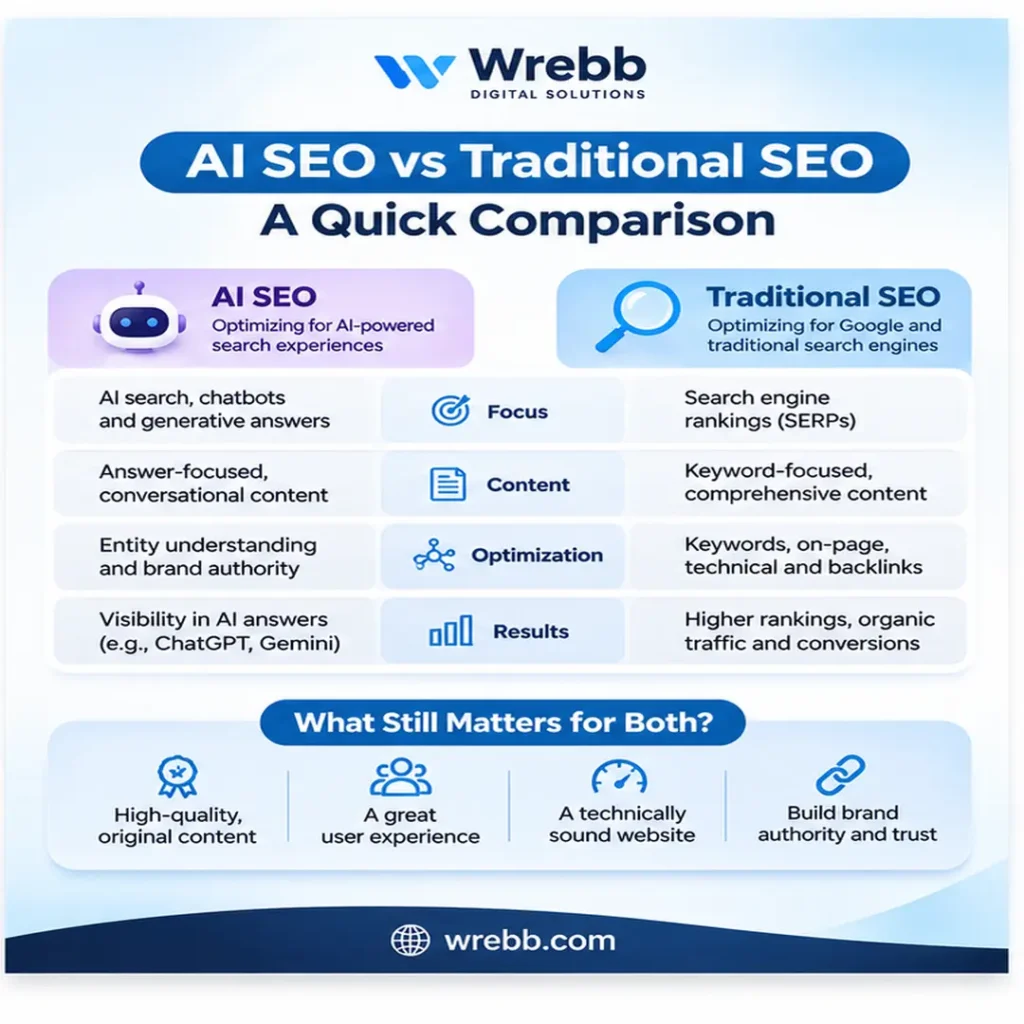
AI SEO vs Traditional SEO: Key Differences
Although both approaches aim to connect businesses with potential customers, they place emphasis on different search experiences.
| Comparison factor | Traditional SEO | AI SEO |
|---|---|---|
| Primary focus | Organic search visibility | Visibility within AI-powered answers |
| Typical user experience | Search results and website visits | Conversational answers and source links |
| Content emphasis | Relevance, quality, and search intent | Relevance, clarity, originality, and verifiability |
| Keyword approach | Search queries and topic relevance | Search queries, questions, and conversational intent |
| Technical foundation | Crawlability, indexing, website performance | The same technical foundations remain important |
| Authority signals | Relevant links, reputation, expertise | Credible, reliable, well-supported information |
| Performance indicators | Rankings, clicks, traffic, conversions | AI citations, referral traffic, brand visibility, conversions |
The important distinction is that these approaches overlap significantly. AI search does not eliminate the need for search-engine accessibility, quality content, or technical optimization.
What Has Changed With AI-Powered Search?
1. Users Are Asking More Conversational Questions
Traditional keyword searches are often short and direct.
For example:
“Best website design company Mumbai”
An AI search query might be considerably more detailed:
“Which website design company can create an affordable WordPress website for my small business in Mumbai?”
These conversational queries provide additional context about the user’s requirements.
Businesses should therefore develop content that addresses genuine customer questions rather than targeting isolated keywords alone.
2. Search Visibility Is No Longer Limited to Rankings
Ranking on the first page of Google remains valuable, but businesses now have additional ways to become discoverable.
AI-generated answers can reference websites, products, publications, and other relevant sources.
A business might gain visibility when its expertise is cited within an answer, even if the user doesn’t immediately visit its website.
This makes it useful to monitor both traditional organic performance and visibility within AI search experiences.
However, appearing in an AI-generated answer does not guarantee a citation, click, or enquiry.
3. Original Expertise Has Become More Important
The internet already contains enormous quantities of generic informational content.
Simply publishing another article that repeats existing advice may offer limited value.
Businesses can differentiate their content through practical experience, original research, detailed examples, customer insights, and expert commentary.
For instance, a web development agency explaining common WooCommerce performance problems can strengthen its article by sharing findings from actual website audits.
Google’s updated guidance recommends producing distinctive, expert-led content that provides value beyond widely available information.
Reference: Google’s Guide to Optimizing for Generative AI Features
4. Brand Visibility Requires Broader Measurement
In traditional SEO campaigns, businesses commonly monitor rankings, impressions, organic clicks, and conversions.
AI-powered search introduces additional questions.
Is your brand mentioned when customers research your services? Are your articles appearing as cited sources? Which competing businesses are referenced alongside yours?
Microsoft introduced an AI Performance report in Bing Webmaster Tools in February 2026, offering insights into how publishers’ content appears across supported AI experiences.
Its reporting has continued to evolve, including information about topics and citation visibility.
Reference: Microsoft Bing Webmaster Blog: AI Performance
These emerging indicators complement traditional analytics rather than replace them.
What Still Matters in SEO?
The comparison of AI SEO vs traditional SEO reveals something important: many foundational optimization practices remain essential.
1. Helpful, People-First Content
Content should answer real questions, demonstrate relevant expertise, and give readers information they can confidently use.
Google continues to recommend helpful, reliable, people-first content.
For businesses, this means creating articles that explain problems clearly, provide practical solutions, and avoid unnecessary keyword repetition.
Reference: Google Search Central: Helpful Content
2. Technical SEO and Website Accessibility
AI-powered search tools still depend on accessible online information.
Search engines need to discover relevant content and understand what individual pages contain.
Technical priorities include:
- Clear website navigation and internal linking
- Indexable pages containing important information
- Logical headings and page structures
- Mobile-friendly layouts
- Reliable website performance
- Correct canonical tags and redirects
A visually attractive website with serious crawling or indexing problems can struggle to gain visibility across search experiences.
3. Relevant Keywords and Search Intent
Keywords haven’t become irrelevant.
They still help businesses understand how potential customers describe their problems, products, and services.
What has changed is the need to consider broader conversational intent alongside conventional keyword targeting.
For example, a business targeting “website redesign services” could also answer questions about redesign costs, timelines, SEO risks, and signs that an existing website needs improvement.
The goal is comprehensive usefulness rather than repeating the same phrase throughout every section.
4. Website Authority and Trust
Credibility remains a fundamental consideration.
Businesses should communicate their expertise through accurate service information, genuine testimonials, transparent company details, useful case studies, and relevant third-party references.
High-quality backlinks and legitimate brand mentions can also contribute to wider discoverability.
However, purchasing artificial mentions or creating misleading endorsements is not a sustainable approach to AI search optimization.
5. Structured Data and Clear Content Organization
Schema markup can help eligible search engines better understand specific types of website content.
For instance, appropriate organization, product, or article structured data may provide useful machine-readable context.
However, adding schema markup does not guarantee that an AI search platform will cite a page.
Clear headings, descriptive content, accurate details, and valid structured data should work together.
Reference: Google’s Structured Data Documentation
How Should Businesses Adapt Their SEO Strategy for 2027?
Understanding AI SEO vs traditional SEO is useful, but the real value comes from applying that knowledge.
Businesses don’t necessarily need to abandon their current SEO strategy. Instead, they should expand it thoughtfully.
Step 1: Strengthen Your Existing SEO Foundation
Start with a website audit.
Check whether important service pages are indexed, whether mobile visitors can navigate comfortably, and whether technical issues are affecting performance.
Fixing fundamental problems should take priority over experimenting with new AI visibility tactics.
Step 2: Build Topic Clusters Around Customer Needs
Create comprehensive content around the problems your target customers are trying to solve.
For a web development company, relevant topic clusters might include website design costs, WordPress development, ecommerce platform comparisons, and website maintenance.
Connect these articles to relevant service pages through descriptive internal links.
This helps visitors explore related information and makes the website easier to navigate.
Step 3: Make Content Clear, Specific, and Useful
Use descriptive headings, natural explanations, relevant comparisons, and examples where they genuinely improve understanding.
For complicated subjects, tables and short summaries can make information easier to follow.
Avoid producing dozens of near-identical pages simply to target minor variations of AI search prompts.
Step 4: Strengthen Your Brand’s Digital Presence
Keep business information consistent across your website, business profiles, and relevant industry platforms.
Publish credible case studies, demonstrate genuine experience, and maintain accurate service descriptions.
Strong brand recognition can support customer confidence regardless of how users initially discover your company.
Step 5: Track Traditional and AI Search Performance Together
Continue measuring organic traffic, conversions, search impressions, and rankings.
Where reliable data is available, supplement these metrics with AI citations, AI referral visits, and recurring brand visibility checks.
Compare results over time and focus on commercial outcomes rather than visibility alone.
Is AI SEO Replacing Traditional SEO?
No. AI SEO is expanding the scope of search optimization rather than making traditional SEO obsolete.
Google’s generative search features continue to rely on its core search ranking and quality systems. The company explicitly recommends established SEO best practices for websites seeking visibility in AI-powered search.
Other AI search systems may use different information retrieval methods, so no single optimization technique guarantees visibility across every platform.
For businesses, the sensible approach is to maintain strong traditional SEO while making content more useful for conversational search and AI-assisted discovery.
Conclusion: Build an SEO Strategy That Works Across Search Experiences
The debate around AI SEO vs traditional SEO highlights a shift in how customers discover businesses, compare solutions, and make purchasing decisions.
While AI-powered search creates new opportunities for brand discovery, the underlying requirements for valuable content, accessible websites, technical optimization, and credibility remain important.
Businesses that combine these foundations with thoughtful AI search visibility strategies will be better prepared for the changing digital landscape.
At Wrebb Digital Solutions, we help businesses strengthen their online presence through SEO-focused website development, content optimization, and digital marketing strategies.
Whether you’re improving an existing website or planning a more comprehensive search visibility strategy, our team can help you identify practical opportunities for growth.
Visit Wrebb Digital Solutions to explore how we can support your business’s digital growth.
Frequently Asked Questions
1. What is the main difference between AI SEO and traditional SEO?
Traditional SEO primarily improves organic search visibility, while AI SEO also considers visibility within AI-generated answers, conversational search experiences, and citations across supported AI search platforms.
2. Is traditional SEO still important in 2027?
Yes. Technical accessibility, useful content, search intent, and website credibility remain important. Google’s official guidance confirms that established SEO practices support visibility in its generative search features.
3. Can AI SEO help my business appear in ChatGPT Search?
Relevant, accessible, trustworthy website content may improve discoverability, but no optimization method guarantees inclusion in ChatGPT Search results or citations within AI-generated answers.
4. What is the difference between AEO and GEO?
AEO focuses on making content useful for direct-answer experiences, while GEO emphasizes discoverability in generative AI responses. Both overlap with traditional content quality and technical SEO practices.
5. Should small businesses invest in AI SEO?
Small businesses should first address website performance, useful content, and local search visibility. They can then explore AI search opportunities through relevant customer questions, expertise, and visibility monitoring.
6. How can businesses measure AI search visibility?
Businesses can review available AI citation reports, monitor relevant brand mentions, examine referral traffic, and track conversions. Results should be interpreted alongside traditional SEO performance metrics.